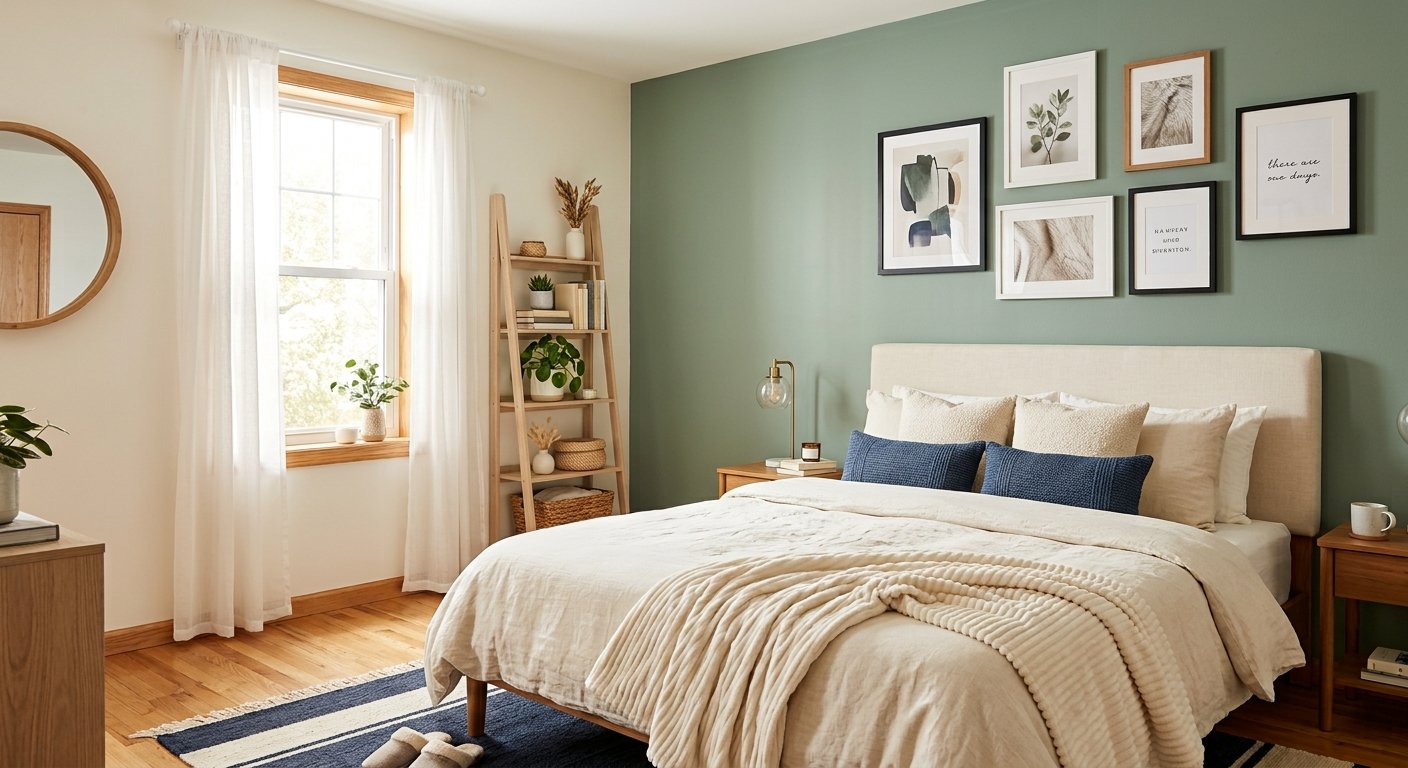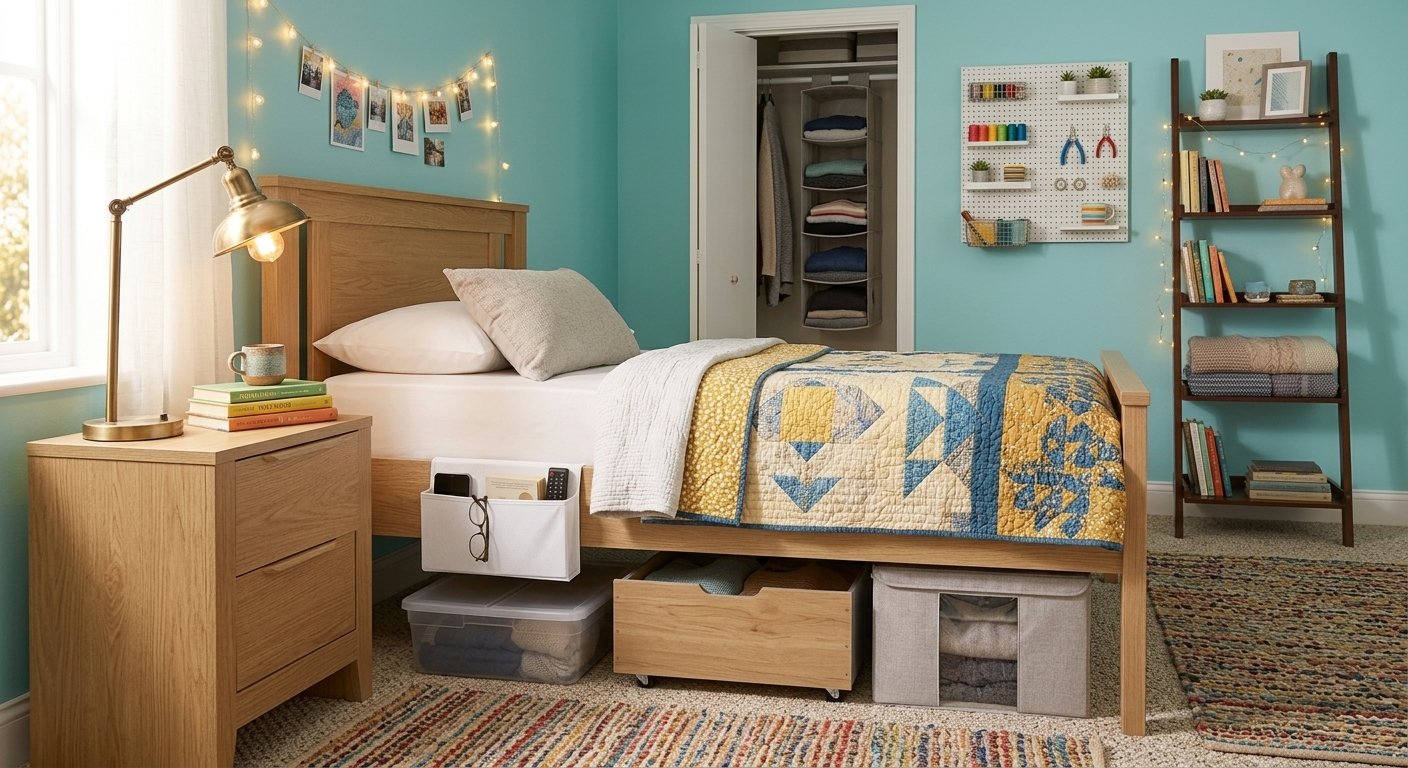
A small bedroom shows you exactly where your stuff doesn't live. The nightstand becomes a pile, the charger dangles behind the bed, and a chair turns into a permanent clothes shelf.
But the real challenge isn't making the room look bigger. It's making a little space work for real life while still feeling like yours.
These 21 small bedroom ideas solve everyday annoyances with smart organization and storage fixes, then add color and personality on a budget. Start with the problem that sounds most like you.
Quick Fixes for Everyday Annoyances
1. Give Your Nightstand a Landing Spot
Small things wander. A ring, hand cream, an earbuds case, and two hair ties start the week in one corner of the nightstand and end it spread across the whole surface. You don't need a bigger nightstand. You need to tell those things where to live.
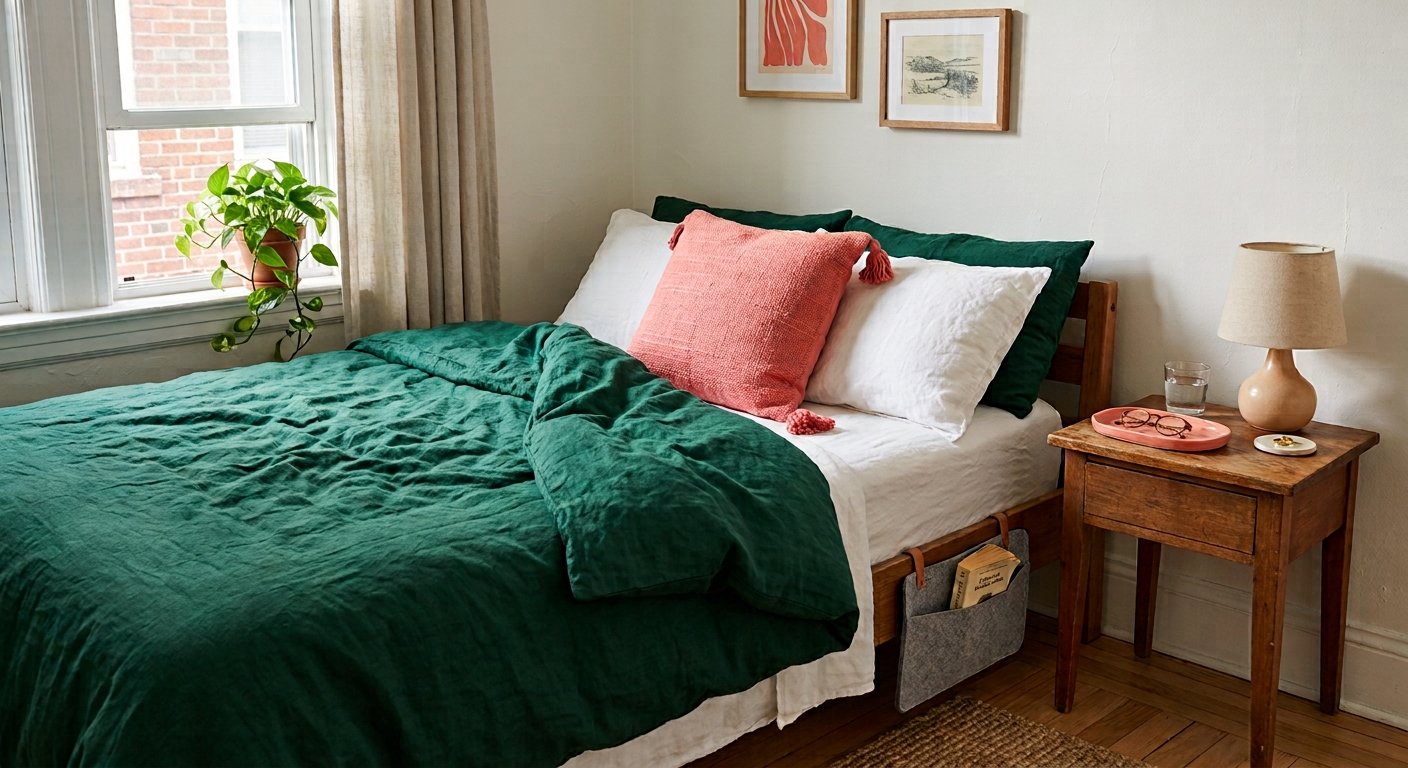
A shallow tray does that. Picture a glossy tangerine dish holding your glasses, lip balm, and ring, with a glass of water beside it and a little bare wood around the edges. It's the same stuff, but now it looks arranged instead of abandoned, because everything sits inside a clear edge.
Choose a tray with a low rim so you can reach in easily, and pick a color you'd like to see first thing in the morning. On a tight budget, a saucer, a small cutting board, or a box lid works just as well.
2. Repeat One Color Three Times
This is the simplest way to make a room look planned without a makeover: choose one color you love and repeat it in three small places. Say it's coral:
- a pillow on the bed
- the tray from idea #1
- a thin frame on the wall across from the bed
Why it works: your eye notices the repetition and reads it as a decision. The pieces don't have to match exactly. They just need to be close enough to feel related, and a photo of your favorite shade on your phone helps when you're shopping.
The usual mistake is sprinkling in five unrelated colors in tiny doses. In a small room, that tends to look scattered instead of playful. One repeated color, plus the neutrals you already own, is almost always enough.
And if you want to start for free, look around first. You may already own three coral-ish things in different corners of the house.

3. Add a Bedside Caddy When There's No Room for a Nightstand
Some bedrooms can't fit a nightstand at all. The bed is shoved into a corner, or the gap beside it is barely wide enough to walk through, so your phone ends up under the pillow and your book on the floor.
A bedside caddy is a fabric organizer with pockets that hangs off the side of the mattress. Your phone, book, water bottle, and glasses sit at arm's reach, and you haven't added a single piece of furniture. That's the principle for very tight rooms: pick things that use a surface you already have, instead of things that need new floor space.
What matters when you shop: a long flat panel that slides under the mattress (flimsy hooks tend to slip), pockets deep enough that nothing tips out, and a slim shape so it doesn't dig into your legs. If your phone charges overnight, look for one with a gap for the cable and add a couple of adhesive cable clips along the frame to keep the cord from wandering.
Make it match: a mustard caddy beside a gray duvet with mustard stripes looks chosen, not stuck on.
Our Recommendation
If there's no room for a nightstand, adding more furniture isn't the answer. A bedside caddy gives your phone, book and water bottle a home right at arm's reach, using the side of the bed itself.
4. Give "Worn Once" Clothes a Place to Hang
The clothes chair exists because of a gap in your system. Clothes that are worn but not dirty, or picked out for tomorrow, have nowhere to go. They're not clutter. They're just between places. No amount of tidying fixes that, which is why the pile keeps coming back.
Give that group a home. Imagine three brass-finish hooks in an even row by the door. Yesterday's jeans hang on one, tomorrow's cardigan on another, and your everyday tote on the third. The chair can finally be a chair, and the evenly spaced hooks look like a design choice.
If you rent, adhesive hooks are your friend, but check the weight rating on the package. A tote with a laptop in it is far heavier than a scarf. Over-the-door hooks need no tools at all, and a few hooks on the side of your wardrobe cost very little.
5. Put a Magnet Where the Little Metal Things Keep Vanishing
Bobby pins, tweezers, nail clippers, keys. They slip to the bottom of a drawer or behind the dresser, and you never find them where you need them at 7 a.m.
A thin adhesive magnetic strip, stuck to the side of your nightstand, inside a drawer front, or on the wall beside your mirror, gives them a place to cling. You can see everything at a glance, and nothing rolls away.
Put it somewhere easy to reach but out of the main line of sight, like the side of a dresser. It costs next to nothing and takes a minute, and it solves one of the most irritating little problems in a small room.
6. Swap the Lamp for a Light That Lives on the Bed or Headboard
If the lamp is the biggest thing on a tiny nightstand, or you read after your partner has fallen asleep, a clip-on or rechargeable light solves both problems. It clips onto the headboard, bed frame, or a shelf edge and lights the page, and not much else.
Imagine the nightstand with the lamp gone: just a tray, a glass of water, and room to spare. That's the payoff. The cordless kind needs no outlet and no extra cable, which is the whole point.
What to look for: adjustable brightness (soft enough for a late chapter, bright enough for a real page), a flexible neck so you can aim it, easy USB charging, and a clip wide enough for whatever you're attaching it to.
A clip needs no drilling, so it's friendly to renters. And if you only read a few nights a week, a simple one is plenty.
Our Recommendation
If your lamp is taking up the only surface you have, a small light that clips on or runs on a battery can put the light exactly where you read and give the nightstand its space back.
7. Use the Back of the Door for Everything That Isn't Shoes
An over-the-door shoe organizer is one of the best-kept secrets in small bedrooms, and almost nobody uses it for shoes. The pockets are exactly the right size for rolled socks, scarves, hair ties and tools, sunglasses, lotions and chargers: all the odds and ends that otherwise float around the room.
Why it works: it sorts things by category, you can see them at a glance, and the back of a door is usually bare and ignored. Clear pockets show what's inside. Colored fabric ones add a stripe of color to an otherwise plain door.
The same trick works for laundry. A hanging hamper bag on the back of the door takes up no floor space, and a striped one adds a little personality exactly where there was none.
Before you buy, check that the door still closes with the organizer on it, and let hot hair tools cool before they go in a pocket.
Smarter Storage and Organization
8. Turn a Bare Wall Into a Pegboard
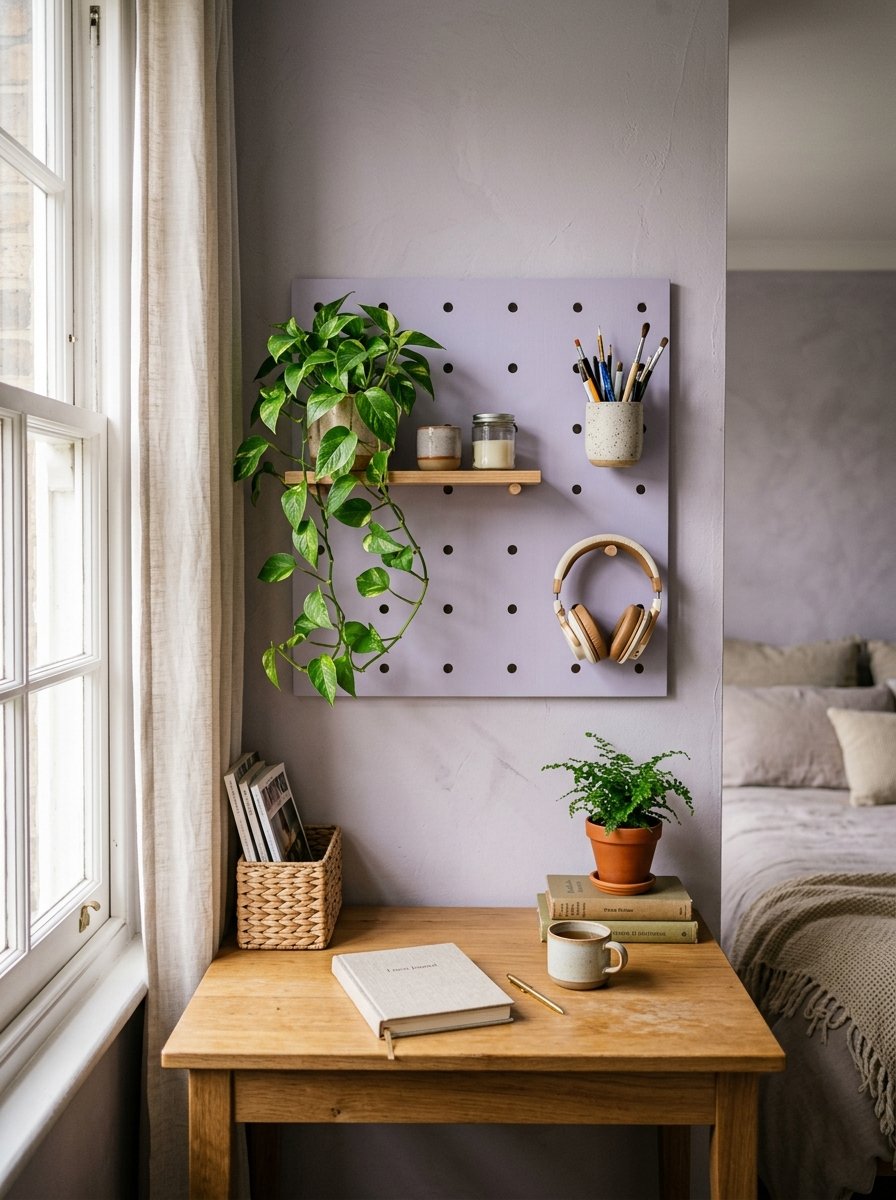
Say you hang a lavender pegboard beside a small desk. A little shelf holds a plant, a hanging cup keeps pens and earbuds tidy, and a hook holds your headphones. When your needs change, you move the pieces instead of drilling new holes.
That flexibility is why a pegboard is worth a look in a bedroom that doubles as a workspace or a craft corner. It turns one empty wall into storage that adjusts as your life does.
Choose a size that fits a wall you actually have free, and buy accessories that are sold to fit the board. Paint it a color you love, then keep the accessories to two or three tones so it doesn't get busy.
On a budget, a single piece of board from a hardware store, painted and mounted properly, costs far less than most ready-made organizer systems.
9. Rescue the Chaos Drawer With Dividers
Open the drawer where socks, belts, chargers, and mystery items collide. If you have to dig, things get shoved back in a heap, and the heap just grows.
Dividers give every category its own lane. Socks in one, belts in another, chargers in a third. Once you can see everything, the drawer stays organized with almost no effort. Measure the inside of the drawer first, and choose adjustable dividers if your drawers differ in size.
The free version works just as well: shoebox lids and small food containers make good trays. And since you're the only one who ever sees the inside of the drawer, line the bottom with wrapping paper or leftover fabric. Opening a drawer to a flash of color is a small, real pleasure.
10. Let Baskets Be the Color, Not the Cover-Up
Most people buy a basket to hide things. In a small bedroom, that's a missed chance. A basket is storage, texture, and a pop of color all at once, so let it show.
A cobalt basket at the foot of the bed holds a folded throw, and a smaller natural-fiber one on a shelf holds the little stuff. Open baskets beat lidded boxes because they're easier to toss things into, which means you'll actually use them.
Measure the exact spot before you buy, and choose a sturdy material that holds its shape. If your room already has lots of patterns, pick a solid or natural-fiber basket. If your room is mostly quiet and neutral, a bold cobalt, rust or emerald basket is the easy way to add life.
11. Use a Narrow Rolling Cart as a Moveable Nightstand
A slim rolling cart gives you storage without the bulk of another piece of furniture. Because it rolls, you can pull it out when you need it and tuck it away when you don't.
The top tier holds tonight's essentials: a book, a glass of water, a hand cream. The lower tiers hold skincare, a small basket of hair products, or spare chargers. In the morning, roll it over to the mirror, and it becomes a getting-ready station.
Good ones are narrow enough to slide between the bed and the wall, have wheels that lock (so it doesn't roll away when you reach for something), and sit at a height you can use comfortably from bed. A cart in mint, coral, or soft yellow adds a cheerful note, especially if it picks up a color from your bedding.

Our Recommendation
If you need storage by the bed but have no space for another piece of furniture, a slim rolling cart can give you shelves that slide out when you need them and tuck away when you don't.
12. Color-Code Your Storage So You Never Have to Hunt
Here's a fun way to make organizing feel less like a chore: give each category its own color. Blue bins for work and hobby supplies, yellow for accessories, green for seasonal stuff. You stop reading labels and just reach for the right color.
It works because your eye finds color faster than it reads words. And it makes a plain row of storage look planned and playful, which matters in a small room where everything is on show.
You can color-code almost anything: fabric bins on a shelf, the hangers in the wardrobe (one color for work clothes, another for weekends), even the cables, using colored cable ties or washi tape.
Keep it to three or four colors so it doesn't turn into a rainbow explosion. For a nearly free start, a roll of colored tape and some old boxes gets you most of the way.
Colorful Upgrades That Add Personality
13. Choose One Strong Color Against a Quieter Background
Small rooms don't have to be beige. They just need a clear hierarchy: one thing the eye lands on first, with everything else supporting it.
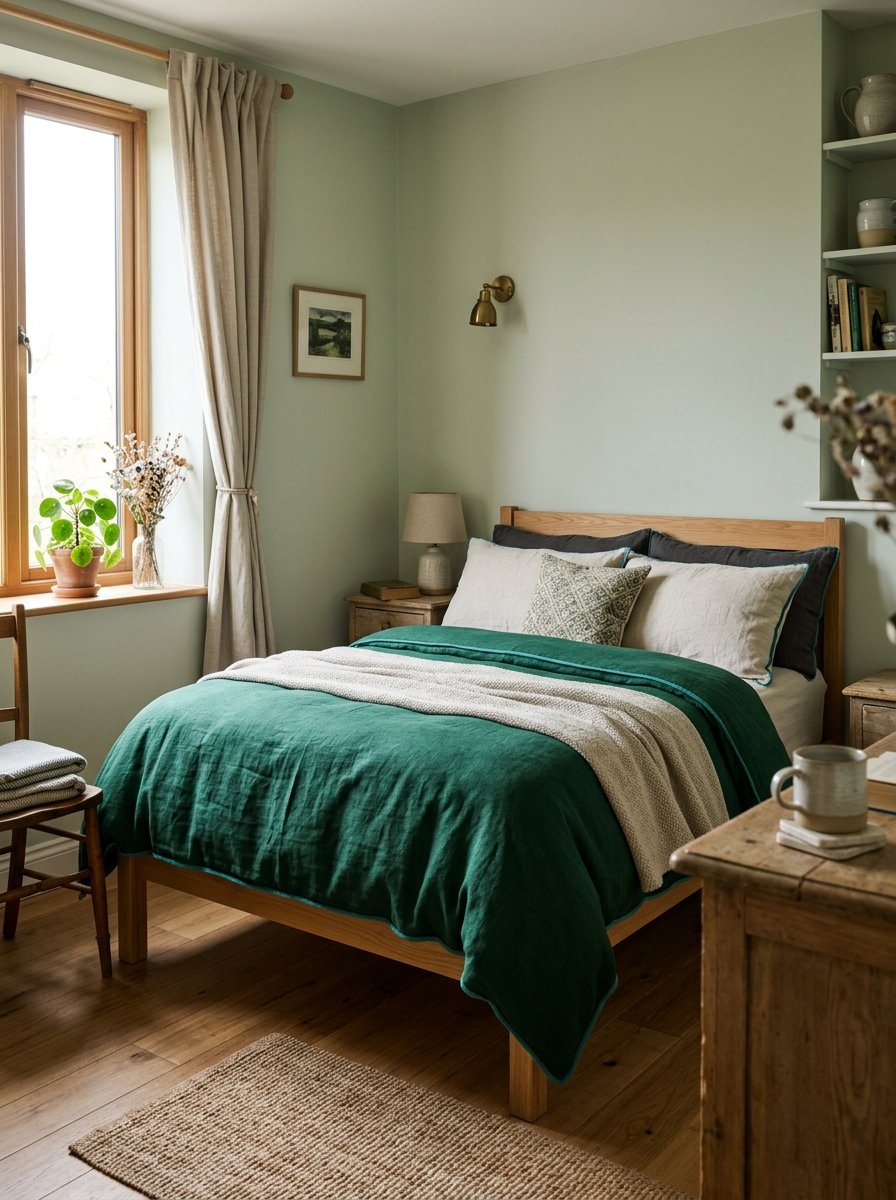
The bed is the best place for it, because it's the biggest surface in the room. Think deep emerald or cobalt bedding against soft walls and simple furniture. The room has a focal point, and everything around it feels calmer by comparison.
A duvet cover is a lower-cost way to do this than a whole new bedding set, and it's easy to swap when you're ready for a change. Then pick up a small detail from it, like a stripe or the thin cord edging called piping, and echo it in one accessory elsewhere. A cobalt caddy beside bedding with blue piping is a good example.
If you love color but get nervous, start with this one thing. It's a low-risk change that makes a big difference.
Our Recommendation
If your room feels flat but you're nervous about color, the bed is the easiest place to start. A bold duvet cover gives the room a focal point without repainting a thing.
14. Mix Patterns With One Simple Rule
Patterns scare a lot of beginners, but the rule is simple: vary the size. Pair one large pattern, like a bold floral duvet, with one small pattern, like thin stripes on a pillow, and one solid. The different sizes keep them from competing.
Sharing one color between the patterns helps too. If the flowers have a touch of mustard and the stripes are mustard, they look like they belong together. Imagine a floral duvet, a striped pillow and a plain mustard throw. It feels collected, not chaotic.
Pillows and a throw blanket are the cheap place to experiment, since they're easy to swap if you change your mind. And if your bedding is already busy, let everything else be solid.
15. Give a Plain Dresser a Colorful Makeover With Contact Paper
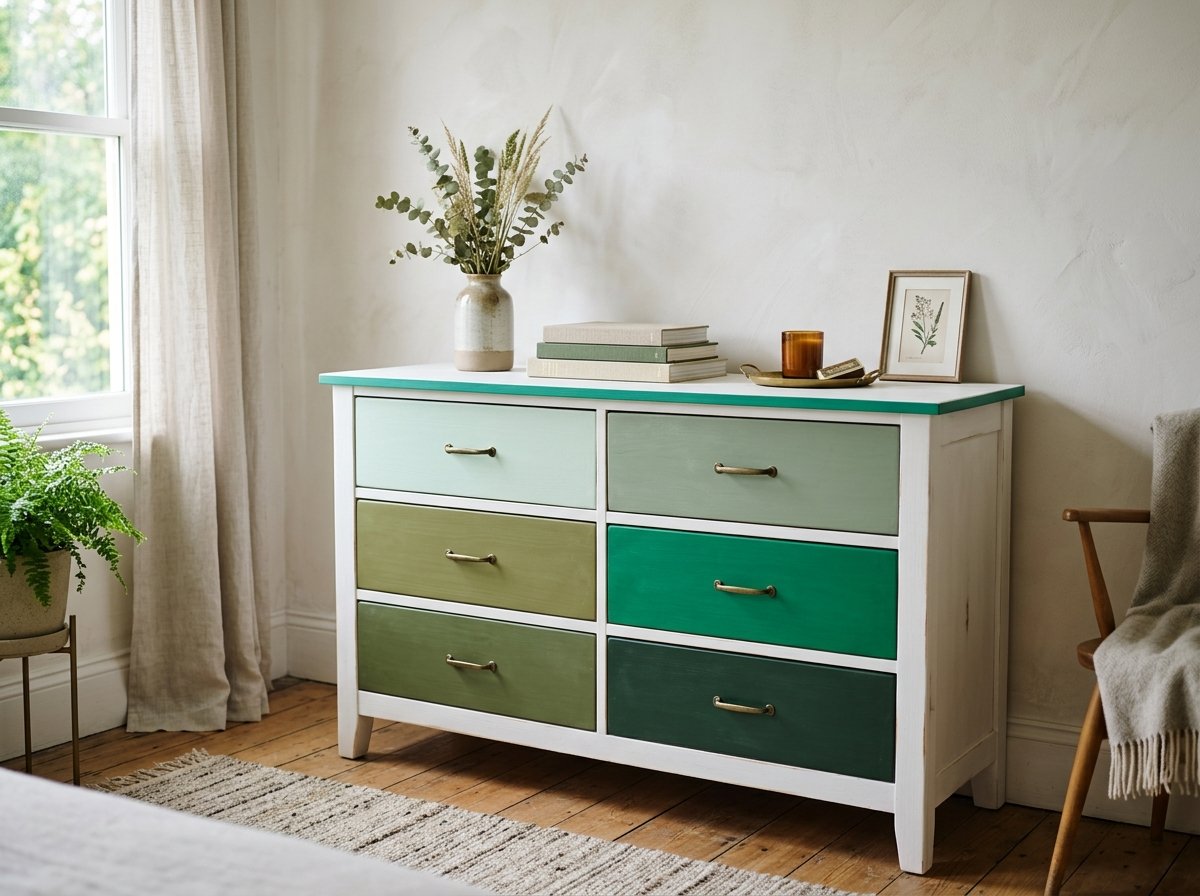
A basic dresser doesn't have to stay basic. Peel-and-stick contact paper is a sticky-backed decorative film that comes in solid colors, patterns, and wood grains, and you can use it to cover drawer fronts, the top of a dresser, or the back panel of a bookshelf.
A white dresser with every drawer front covered in a different shade of green looks fantastic, and so does one bold stripe across the top. It looks custom, but it's far less of a commitment than paint. It also hides scratches and stains you don't love.
Why it works for beginners: no paint, no drying time, and no sanding. It's also easy to redo if you change your mind. Clean the surface well first, work slowly to avoid air bubbles and test a small hidden spot to make sure it peels off cleanly, especially if you rent or if the furniture isn't yours.
16. Let a Small Rug Be the Color Anchor
A rug does two jobs in a small room: it makes the floor feel warm and soft, and it's one of the easiest ways to introduce color without touching a wall. Think of a striped rug in terracotta and cream beside the bed, so the first thing your feet find in the morning is something cheerful.
A small rug works as an accent, so it doesn't need to fill the room. Pick a color that appears somewhere else too, as your throw pillow, and the whole space will pull together. If your bedding is plain, you can be bolder with the rug. If your bedding is busy, choose a simpler one.
Look for something with a non-slip backing, or add a rug pad. A thin, flat-woven cotton rug can often go in the washing machine, which is a real bonus (check the label).
17. Use Removable Wallpaper on One Small Area
You don't need to cover every wall to get the effect of wallpaper. In a small room, one small area is often more striking and less overwhelming.
A panel of botanical print behind the bed can read like a headboard. Or try the back of an open bookshelf, the inside of a closet door, or the front of a dresser.
Peel-and-stick wallpaper is renter-friendly, and when you want a change, it comes off without damage (check the instructions for your wall type).
Small, repeating motifs feel calm. Big graphic prints make a statement. One roll is often enough for a single panel, which keeps the cost low.

Our Recommendation
If you want a bold pattern but can't or don't want to repaint, a single panel of peel-and-stick wallpaper behind the bed or inside a bookshelf adds a lot of personality in a small area.
18. Swap the Hardware and the Switch Plates
The knobs on a plain dresser and the white plastic plate around your light switch are easy to overlook. They're also two of the fastest ways to change how a room feels.
Brass, ceramic, or painted knobs make an ordinary dresser look custom. A patterned or colored switch plate gives you a tiny surprise every time you walk in. Both are small, both are cheap, and both take a screwdriver and a few minutes.
Before you buy knobs or handles, measure the distance between the screw holes so the new ones fit, and stick to one playful detail. Mismatched ceramic knobs in different colors are a fun one. If your room already has a lot going on, choose a single finish, like brass, and repeat it.
19. Let the Curtains Carry the Color
If you've been told small rooms need white curtains, here's another view. Curtains are one of the biggest fabric surfaces in the room, which makes them a great place to put color. And you're not trying to make the ceiling look higher. You're giving the window a personality.
Hang mustard or deep teal curtains at a small window, keeping a plain white bed and a neutral rug. The window becomes the thing you notice, and the rest of the room can stay quiet. Or go the other way: simple cream curtains with a bold stripe, if your bedding is solid.
Two tips: choose a fabric that lets in some light if your room is dark, and make sure the color shows up somewhere else (a pillow or a basket) so it feels connected. A spare bedsheet in a bright color, hung on a tension rod, is a budget-friendly stand-in.

Personal Touches and Cozy Extras
20. Hang a Mini Gallery of Things You Actually Love
Personality doesn't need a big display. It needs a few things that mean something to you.
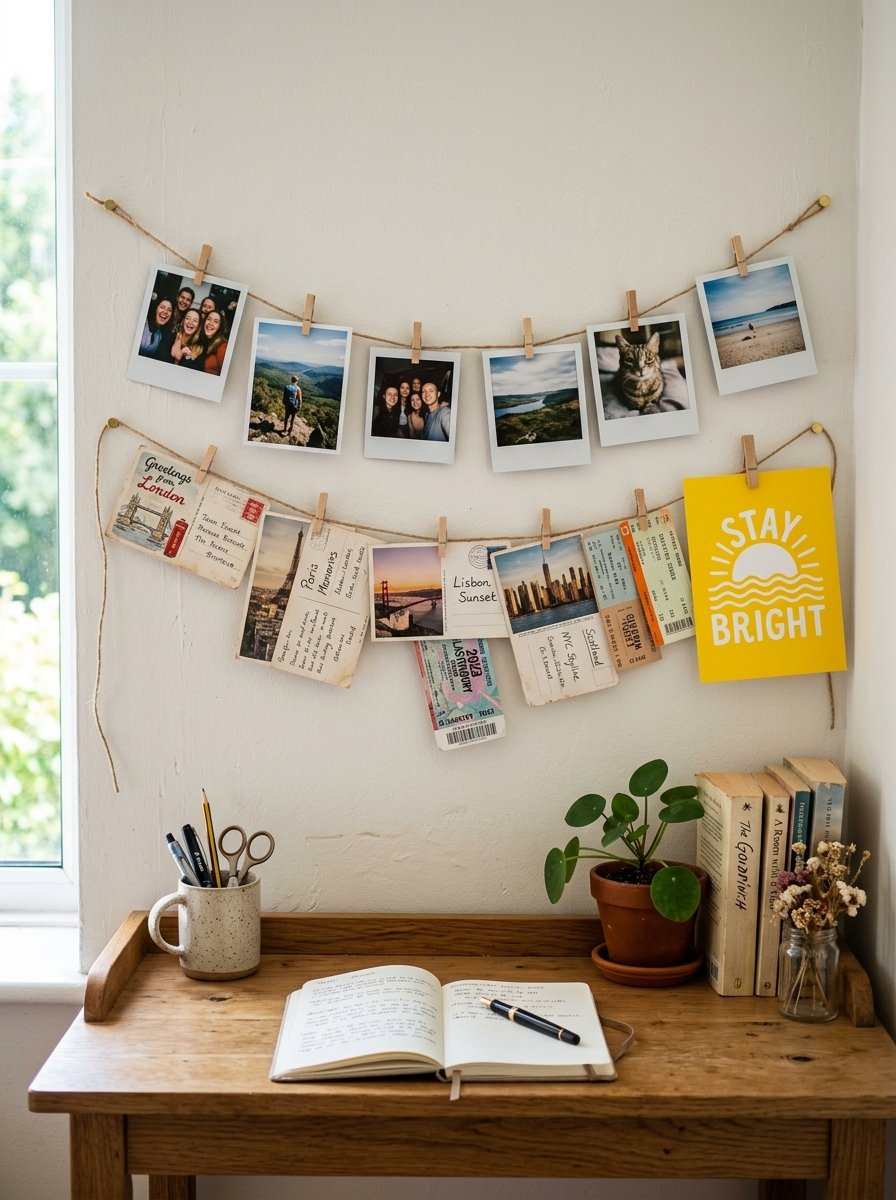
Imagine a length of twine across the wall above the desk, with photos, postcards, and ticket stubs held up by small clips, plus one bright yellow print at the end. It takes up almost no space, costs next to nothing, and changes whenever you feel like it.
Keep one thing consistent, like the clip color or a frame finish, so a mix of different things still looks tidy. Use damage-free hanging strips if you rent, and rotate what's on show every few weeks so it never gets stale. Three to five items is plenty.
21. Make the Bed a Comfortable Place to Hang Out
In a small room, the bed is often the only place to sit, so make it a good one. A foldable bed tray or lap desk turns it into a spot for breakfast, a laptop, or a puzzle, and a colorful backrest pillow makes it comfortable enough to stay a while.
Choose a tray with legs that fold flat, so it slides behind a door or beside the wardrobe when you're done. If you use it for work, check that the surface is big enough for your laptop and a mug. And if you're on a budget, a sturdy cutting board over your lap does the job in a pinch.
A bed that's comfortable to lounge on means you won't miss the chair in the corner, the one that was really just a clothes pile.
Your Simple Action Plan
You don't have to do all 21 of these. Here's a gentler way to approach it:
1) Identify the biggest annoyance in the room.
Is it the cluttered nightstand? The pile of clothes on the chair? The tangle of cables?
2) Fix that problem first.
Choose the idea above that matches it, and start there.
3) Add one useful upgrade. A caddy, a hook, a drawer divider- whichever fits your room.
4) Add one colorful or personal detail.
Repeat a favorite color, swap the hardware, or hang a small gallery.
5) Stop before the room gets crowded.
A small bedroom looks best when it has a bit of breathing room, so when you feel the urge to add one more thing, pause.
A small bedroom doesn't have to give up personality for practicality. With a few well-chosen changes, it can do both.
Frequently Asked Questions
How can I make a small bedroom more fun?
Start with one thing that makes you smile: a bold duvet cover, a colorful tray, or a little gallery of things you love. Fun comes from personality, not from adding more stuff, so pick a few details that feel like you and let them stand out.
How can I add color without making a small bedroom feel cluttered?
Repeat one color in two or three small places, and keep the rest of the palette quiet. Choosing solid colors for larger items and saving patterns for small accessories also helps keep things calm.
What are the best accessories for a small bedroom?
The most useful ones solve a daily annoyance: a bedside caddy or tray, a clip-on reading light, a few good hooks, and a set of drawer dividers. Choose ones that use surfaces you already have rather than taking up new floor space.
How can I organize a small bedroom without buying new furniture?
Give every group of items a defined home. Trays, dividers, hooks and baskets do a lot of work without needing new furniture, and many of them can be made from things you already own.
What are some small bedroom ideas on a budget?
Hardware swaps, hooks, trays, drawer dividers made from boxes, a mini gallery, and the three-times color trick all cost very little. Spend a bit more only on things you'll use every day, like good bedding or a reliable reading light.
How can I make practical storage look decorative?
Choose storage in colors, textures, or patterns you actually like, and display it instead of hiding it. A woven basket, a painted pegboard, or a neat row of hooks can look just as good as a decorative object.
What should I buy first when decorating a small bedroom?
Buy the thing that fixes your biggest daily frustration. For many people, that's a bedside organizer, a few hooks, or a clip-on light. After that, add one colorful piece to make the room feel like yours.