Small bathrooms have a talent for looking messier than they are. Six half-used bottles on the counter, one harsh ceiling bulb, towels from three different sets, and suddenly the whole room feels cheap.
The good news is that you don't need a renovation to fix it. Most small bathroom decor ideas that look expensive come down to kinder lighting, repeated colors, and storage that hides the clutter.
Here are fifteen changes, grouped by the problem they solve, and most of them work for renters too.
When Nothing in the Room Matches
1. Pick a Palette Around Your Tile
Hold a plain white towel up against your tile. That one test tells you which direction to go.
If the tile looks yellowish, warm whites, creams, and soft beige will sit comfortably next to it. If it leans gray or blue, try greige (a gray and beige blend), crisp white, and muted sage.
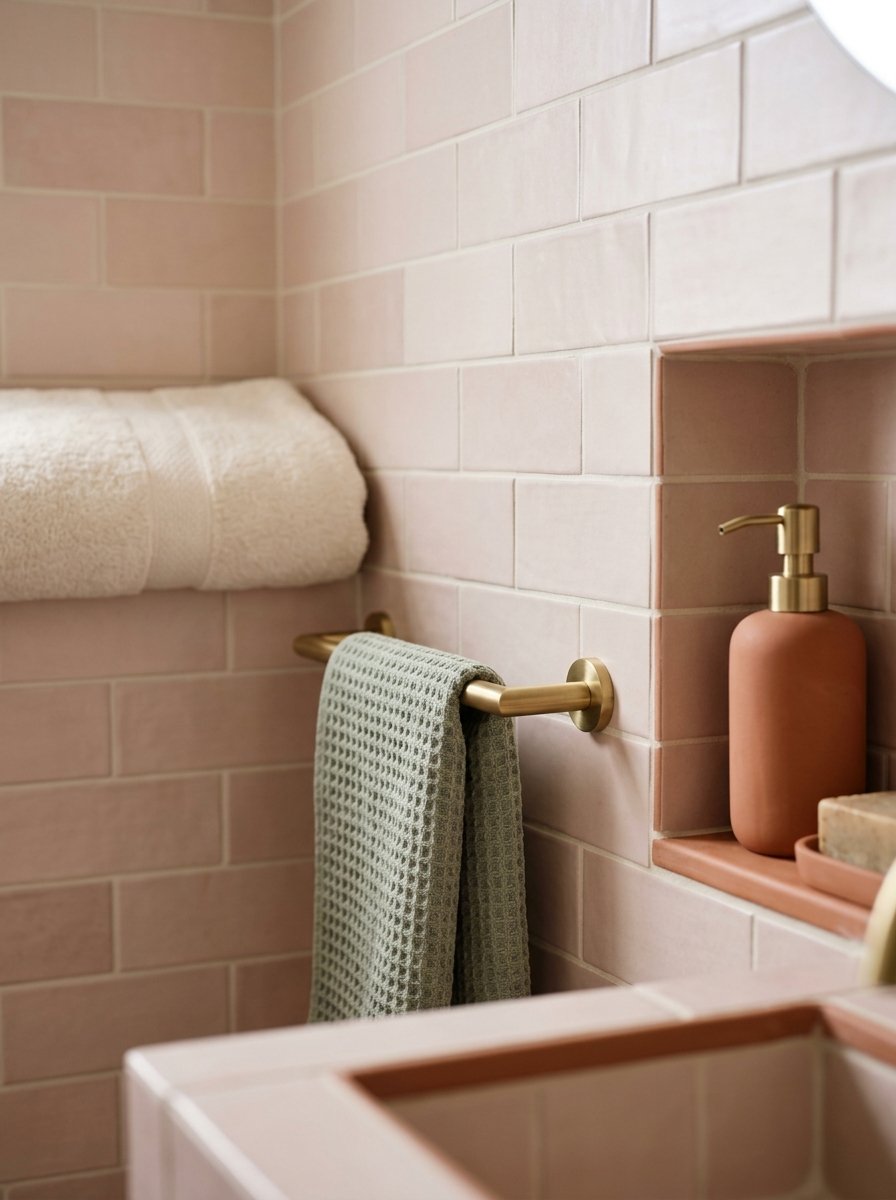
If your tile is the dusty pink or mint green common in older buildings, this test saves you a lot of guessing.
From there, stick to one main color, one lighter partner, and one deeper accent.
Cream towels, a pale greige curtain, and a single matte black detail make a complete palette. Add a little wood or a plant so it doesn't feel cold.
2. Repeat One Metal Finish
A chrome faucet beside a gold towel bar and a black soap pump looks like three strangers sharing a room. None of them is ugly on its own; they just clash when they're together.
You probably can't change the faucet, so match the easy swaps to it. That means cabinet pulls, the towel bar, the toilet paper holder, and hooks.
Chrome pairs well with white and warm wood, and brushed nickel pairs well with cream and gray. Two finishes are the limit.
Before you order new pulls, measure the distance between the two screw holes, center to center, so the new ones fit the old holes with no drilling.
When the Mirror and the Lighting Let You Down
3. Choose a Mirror Shape That Fits Your Layout
The mirror does more for a room's sense of size than any other single piece, so don't go small. Aim for one slightly narrower than the vanity so it looks anchored instead of floating.
A round or oval shape softens a room full of square tile, a tall rectangle makes a low ceiling feel higher, and a wide one suits a long vanity.
Hang it with the center at eye level for whoever uses the room most, and pick a frame in your repeated metal or a simple wood tone.
4. Let the Mirror Store Things Too
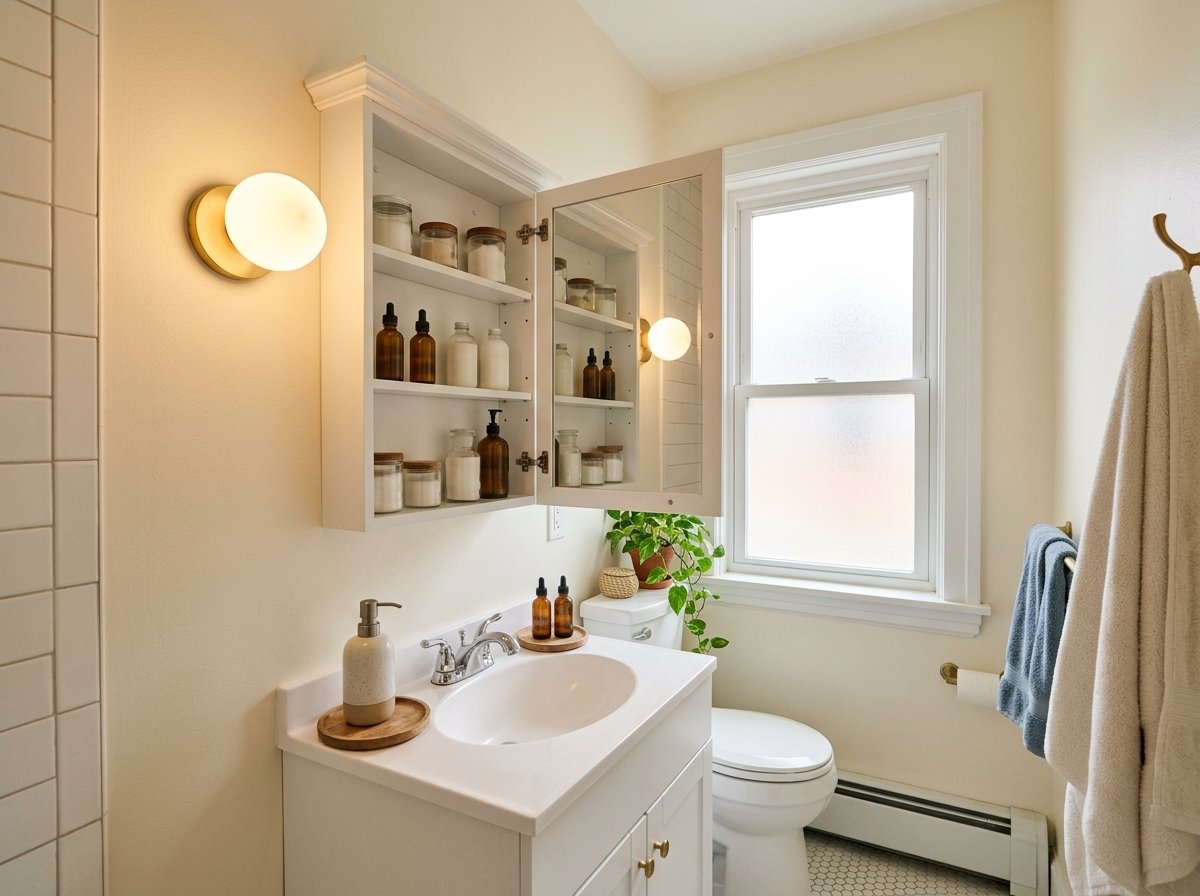
What if the mirror held your toothpaste too? A medicine cabinet with a mirrored door clears the counter and gives you the mirror in one purchase.
A surface-mount cabinet hangs on the wall like a framed picture and screws on with no cutting, so it's the easier route.
A recessed one is set into the wall like a built-in bookshelf. It looks seamless, but it means opening the wall, so bring in a pro if you're unsure.
Renters should check the lease before drilling.
Our Recommendation
If the counter is crowded because the drawers are already full, a mirror that doubles as storage is an easy way to clear it. Here are some budget-friendly and trusted options.
5. Light Your Face, Not the Ceiling
Light from above does you no favors. A single ceiling bulb throws shadows under your eyes and makes everything look flat, so that tired 7 a.m. face is partly the bulb's fault.
Light from beside or above the mirror is far kinder. Two sconces at eye level, one on each side, are the classic setup, and a light bar above the mirror is the simpler version.
For bulbs, look for warm white at about 2700K to 3000K. The K stands for color temperature, and lower numbers look warmer. Also check for a CRI of 90 or higher, which tells you how true colors look under the light.
Before you buy any fixture for this spot, check the label for a damp-location rating. It means the fixture is made for steamy rooms, and it's usually printed on the box or the product page.
Changing a bulb is a two-minute job. Replacing a hardwired fixture is different. That's one wired straight into the wall with no plug, and you'd need to shut off the breaker- the switch in your electrical panel that cuts power to the room.
Hire a licensed electrician if that's new to you, and keep plug-in lights well away from the sink and tub.
Our Recommendation
If one overhead bulb leaves your face in shadow, better lighting around the mirror makes a bigger difference than any decor. Here are some trusted options to choose from.
When the Towels Are Fighting Each Other
6. Match Your Towels, Bath Mat, and Curtain
Mismatched towels are the quickest way to make a bathroom look budget, and most of us have one faded survivor in the stack.
Pick two colors from your palette and keep every soft item inside them. White or cream towels with a textured greige curtain give you that boutique-hotel look without a single expensive piece.
Thick, plush towels sound luxurious, but in a small room with little airflow, they can stay damp for ages.
A lighter cotton or a waffle weave (a honeycomb texture that dries faster) is often the smarter daily pick. Hang bath towels on hooks and fold a single hand towel by the sink.
Our Recommendation
A cheap-looking shower curtain can pull the whole room down, so a better texture is a quick upgrade. Check out our picks.
7. Size Textiles So Daily Life Stays Easy
Get the curtain and mat sizes wrong and even a pretty setup turns annoying. Hang the shower rod a few inches below the ceiling and choose a curtain long enough to clear the tub edge.
The room reads taller, and the hem won't pool on the floor and collect mildew. Mats need measuring too. Check the clear floor between the tub and the door swing, then buy one that fits inside it.
Oversized mats jam the door and curl at the corners, so you end up straightening them every morning. Go for machine-washable, because a mat you can't wash won't stay nice for long.
When Every Surface Is Covered in Stuff
8. Use the Cabinet Under the Sink Properly
Reach under the sink for a spare toothbrush and a bottle of shampoo hits the floor. Most of us have this cabinet.
Before you buy anything, empty it, toss what's expired, and measure the width, the depth, and where the drain pipe sits.
A two-tier slide-out organizer that curves around the pipe nearly doubles the usable space. Clear bins let you group first aid, hair products, and spare soap so you can see what you own.
Keep daily items in front and backups at the back, and use drawer dividers to do the same job inside vanity drawers.
Our Recommendation
If everything under the sink ends up in one pile, an organizer that works around the pipe gives you the space back.

9. Go Vertical Above the Toilet and Behind the Door
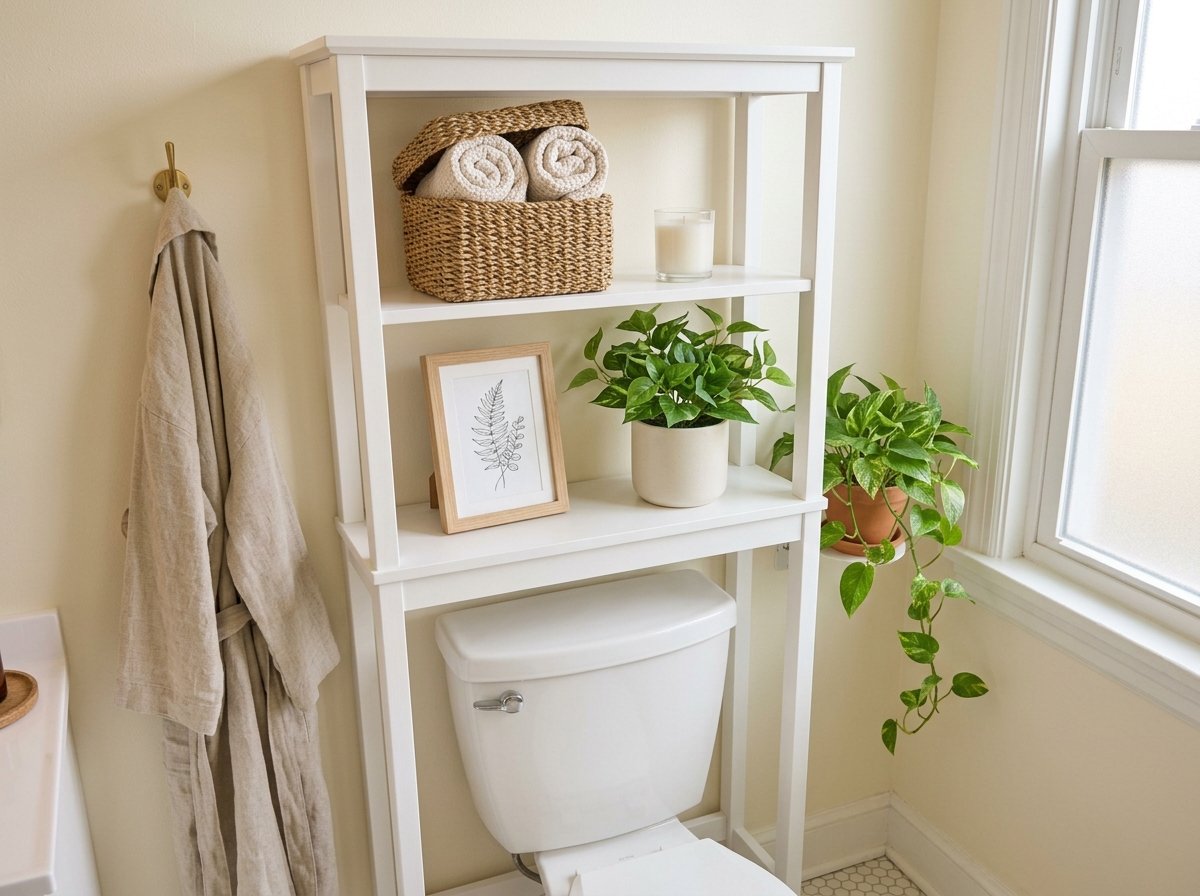
The wall above the toilet is the most wasted space in most small bathrooms. A freestanding shelf unit stands on the floor with a leg on each side of the toilet, so there's no drilling, which suits renters.
Wall shelves look lighter but need proper anchors (the plastic or metal plugs that let a screw grip drywall), and you'll want enough room above the tank to lift the lid.
Behind the door, add hooks for robes and towels. Over-the-door hooks work, and so do adhesive ones rated for bathrooms and the weight you'll hang.
Out in the open, show only three or four things, like rolled towels, a candle, and a plant, and tuck the rest into lidded baskets.
For more space-saving ideas, see our small bedroom storage guide
Our Recommendation
When there is no floor space left, the wall above the toilet is the easiest place to add storage. Here are a few to choose from.
10. Make a Tiny Vanity Work Harder
What helps depends on which sink you have.
- Pedestal sink. This is a sink on a single column with open space underneath. It has no storage, so a slim shelf or the over-toilet unit takes the overflow.
- Wall-mounted vanity. This is a small cabinet bolted to the wall with floor showing below. It usually has one shallow drawer, so dividers matter most.
- Cabinet vanity. This is a sink sitting on a full cabinet. It gives you room, but the counter should still stay nearly clear.
Use a tray to gather the daily items, like soap, lotion, and the toothbrush cup. A wall-mounted holder or a hook inside the cabinet door keeps hair tools and their cords off the counter and out of the soap dish.
Measure around pipes and drawer paths before buying, because an organizer that blocks the faucet or a drawer takes more room than it saves.
Our Recommendation
If the same five items always end up scattered across the counter, a tray gives them one tidy home.
Walls, Plants, and Texture
11. Hang Art That Survives Humidity
Steam is hard on art. Unsealed canvas and unframed paper curl and warp fast, so stick to framed prints behind glass or acrylic (a clear, lightweight plastic) and hang them away from the shower.
The best spot in a small bathroom is the wall above the toilet, where a piece about 16 to 24 inches wide fills the space without crowding it.
Beside the mirror, two small frames of the same size hung a couple of inches apart look tidy. Pull the colors from your palette, and use adhesive strips rated for the frame's weight if you're renting.
12. Add Natural Texture Without Visual Noise
An all-white bathroom starts to feel like a waiting room because it's missing texture, not color.
Pick three materials and use each one twice, like a wood tray and a small wood stool, a ceramic soap dispenser and toothbrush cup, and two woven baskets, one for spare rolls and one for towels.
Choose finishes that handle moisture, such as sealed wood, bamboo, teak, ceramic, and resin, because raw, untreated wood warps, and anything delicate doesn't belong beside the sink.
13. Choose Plants by the Light You Have
Check your light before you buy a plant.
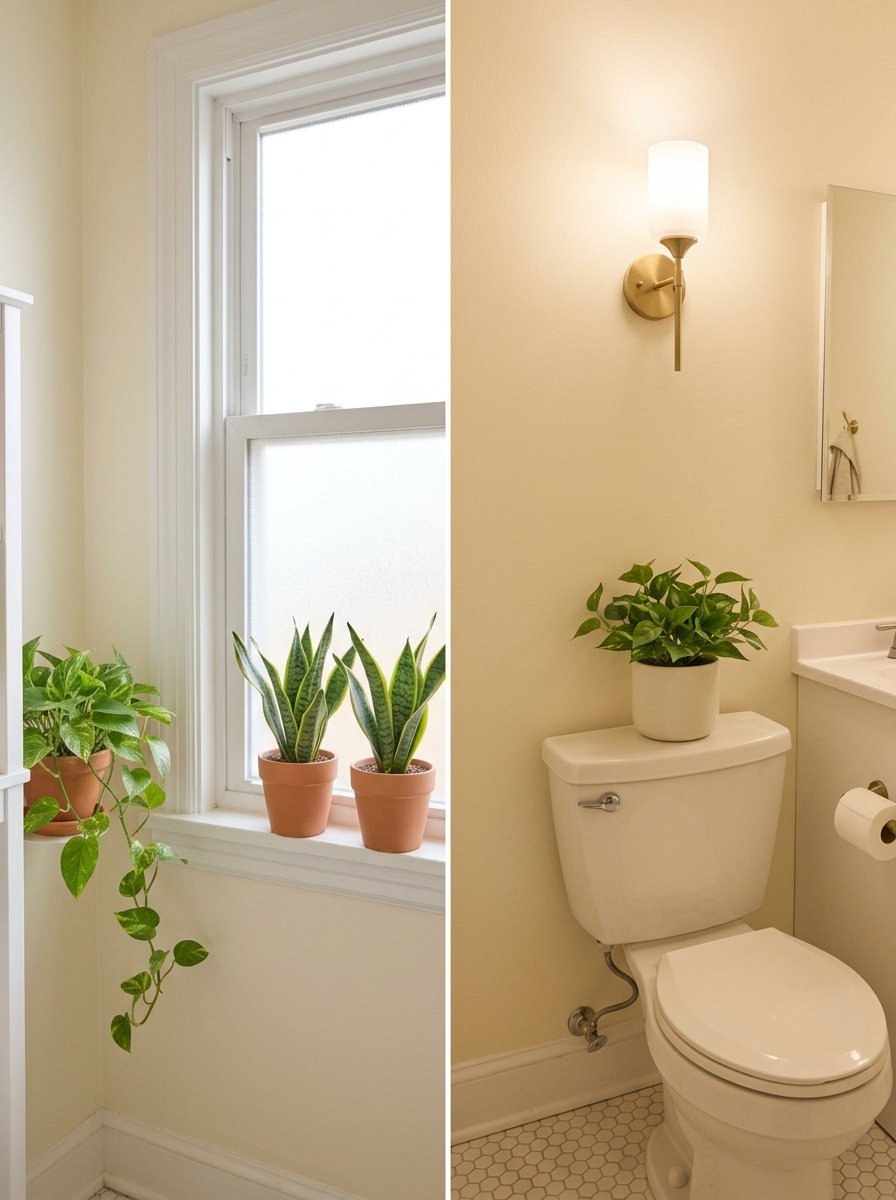
- You have a window with some daylight. Pothos, snake plants, and ZZ plants cope well with humidity and lower light. Ferns love humidity but need brighter light than many bathrooms offer.
- You have no window. A real plant will slowly fade. Choose a good faux plant in a ceramic pot, skip shiny bright-green leaves, and wipe off the dust monthly.
Either way, one small stem on the back of the toilet tank is enough to change how the room feels.
Updating a Dated Bathroom Without Renovating
14. Refresh Dated Tile, Fixtures, and Finishes
Dated tile and a no-renovation lease is a common pairing, and you can still do plenty. Quiet the tile instead of fighting it.
Neutral textiles, a pale curtain, and fresh hardware pull the eye away from it. Then clean up any discolored grout, which is the lines between tiles, and redo cracked caulk, the flexible seal along the tub and sink edges. Both cost very little and make everything look newer.
Peel-and-stick tile and wallpaper work best in dry areas, like the wall beside the vanity. Steam and direct water lift the adhesive, and removal can take paint with it.
Test a small piece first, and skip anything permanent if you're renting.
15. Finish With a Simple Styling Formula
Choose one direction. Warm minimalist means cream, wood, and matte black. Modern organic means soft green, stone, and woven texture. Hotel-inspired means white, brushed nickel, and folded towels.
Then repeat two or three colors and two finishes, leave some counter empty, and stand in the doorway to look at the room the way a guest would.
Take one item away, since there's almost always one too many. Finally, run through this quick check.
- Does every soft item stay inside two or three colors?
- Do the metals match, or pair on purpose?
- Is the counter mostly clear?
- Is the lighting warm and even?
- Does everything have a home?
For more renter-friendly updates, you can see our apartment bedroom ideas
Where to Spend First When Money Is Tight
Spend in the right order and you may skip the later steps entirely.
1) Declutter and reuse. Clear the counter, then put back only what you use daily. Use what you already own as storage before buying any.
2) Fix the bulbs. Warm, high-CRI bulbs cost little and change the whole room.
3) Replace the visible soft items. A matching towel and curtain set does more than any single accessory.
4) Swap hardware. Pulls, hooks, and a towel bar give a fast upgrade.
5) Add storage once the clutter is gone. By then you'll know which things truly have no home.
Save mounted items for last. A new mirror or light fixture costs more and takes more effort.
Durable items are worth a little more. That means anything mounted, anything that gets wet daily, and anything you handle every morning, like a solid medicine cabinet or a shower rod that won't rust.
Picture a white-tile bathroom with a chrome faucet. In one weekend you swap the bulbs, clear the counter down to three items, hang a cream curtain with matching towels, switch the cabinet pulls to chrome, and add one framed print. Nothing structural changes, and the room reads like a different space.

Common Small Bathroom Decorating Mistakes to Avoid
- Buying organizers before measuring. The classic regret is an organizer that loses to a drain pipe or a door swing.
- Blocking daily movement. Big mats, deep shelves, and tall baskets get in the way every morning.
- Using too many colors and objects. In a small room, everything competes, and the whole thing reads as messy.
- Ignoring moisture and mounting safety. Humidity ruins the wrong materials, and heavy items need real anchors.
- Buying before finding the problem. Decide what bugs you most, then solve that first.
A beautiful small bathroom comes from thoughtful choices, not from buying everything new. Kind lighting, storage that fits, and a short list of repeated colors do more than any single expensive piece.
Tomorrow morning, while you brush your teeth, notice the one thing that bugs you most. Fix that first, then see what's still worth changing.
Frequently Asked Questions
How can I make a small bathroom look expensive on a budget?
Focus on lighting, matching textiles, and a clear counter. Warm bulbs, one coordinated set of towels and a curtain, and matching hardware change the room more than any single decor piece. Reuse what you own before you buy anything.
What colors make a small bathroom look bigger?
Light, warm neutrals like soft white, cream, and light greige reflect light and keep the room calm. Use a deeper color in small amounts. When the towels, curtain, and walls sit close in tone, the room feels less chopped up.
How do I decorate a small apartment bathroom?
Stick to changes that don't touch the walls. Swap hardware, textiles, and bulbs, add a freestanding shelf over the toilet, and use adhesive hooks rated for bathrooms. Check your lease before drilling, painting, or replacing fixtures.
How can I update a small bathroom without renovating?
Start with what you can see and swap. New hardware, textiles, a fresh mirror or medicine cabinet, better bulbs, and clean grout and caulk all help. Use peel-and-stick products only in dry areas.
How do I make a small bathroom look less cluttered?
Give every item a home and keep only daily items out. Use under-sink organizers, drawer dividers, and a lidded basket for extras. Measure before you buy, so the storage doesn't take more room than it saves.